
Happy? New? Year!
A challenge to sing a Messiah solo led to a moment, led to a faded painting, led to a happy new year a half a lifetime ago.
.jpg)
Well, despite my heart going pitter-patter, my mouth going dry, and being forced into singing it without the music because I hit the wrong spot on my iPad screen at the last minute, I somehow made it through my Messiah bass solo and lived to tell the tale. Just two minutes’ worth of recitative action (which is probably a good thing). The church was packed with singers and music lovers, and friends were sprinkled throughout. It turned out to be a much more enjoyable and important experience than I expected, and not just because it went better than either of the rehearsals had. I’ll explain by way of a few comments I received.
“Amazing” – I like this one, cause it can be amazingly good or bad, so the person’s covered either way, right?
“You sounded great” – Always nice to hear!
“You sound more like a lyric bass” – This from an opera singer, who used what turns out to be a technical term. In the American vocal universe, bass singers are classified as bass-baritone, comic bass (in Italian, basso buffo), lyric bass (basso cantante), or dramatic bass (i.e., basso profondo). Who knew? And I admit I kinda like the sound of lyric bass.
“I heard a bit of the pop singer in there” – Hey, I would’ve been really surprised if they hadn’t!
“You really had a moment up there” – This is the one that got me thinking the most…
When I remember back on it, over a week ago now, I think I really did feel that moment. I really think I recognized it was a moment. Something bigger than I expected. While the long, somber intro played, I prayed, “Lord, help me tell your story,” and I felt that story as I was singing it. I felt it shift from the gloomy realism of “Darkness shall cover the earth, and gross darkness the people” to the life-changing hope of “But the Lord shall arise upon thee…” And after it was all over and I walked trembling back to my seat, I felt like something new had happened, some line had been crossed, I’d stretched myself in a new way—which somehow made singing all the following choruses all the sweeter.
So there’s the report I promised you, but as I was trying to make sense of all that and put it together with what I’m reading now in Flow, by Mihaly Csikszentmihallyi, I started thinking about what that new experience really meant, and why it was important. The book is all about the psychology that goes into making an experience a happy one, an enjoyable, memorable event that becomes a signpost to some new and important aspect of your life. It is gonna be a new year, after all. And we’re starting to wish people a happy one. But what will make it happy?
I’ve always believed that happiness was a lot more than just what happens to you. It’s not just happen-ness. I grew up hearing Bible verses like “Count it all joy… when you meet trials of various kinds, for you know that the testing of your faith produces steadfastness” (James 1:2–4) and “We rejoice in our sufferings, knowing that suffering produces endurance… and hope does not put us to shame.” (Romans 5:3–5). Or to give some time to the Old Testament, “Many are the afflictions of the righteous, but the LORD delivers him out of them all.” (Psalms 34:19). It’s obvious there’s something a lot deeper than circumstance going on here.
Flow was recommended by a friend one day as I was telling her about something that had just seemed to, well, flow. You know, when things just seem to work right, and feel right. Csikszentmihallyi made a scientific study of what it is that creates this optimal state of experience, and turns out he is the leading authority on the subject. But he starts out by quoting the Austrian psychologist, Victor Frankl: “…success, like happiness, cannot be pursued; it must ensue…as the unintended side-effect of one’s personal dedication to a course greater than oneself.” Uh, huh. I thought so. But wait a minute. Our own Declaration of Independence claims it’s our inalienable right to pursue happiness, yet we can’t pursue it?
What the author discovered through his years of research was that “happiness is not something that happens. It is not the result of good fortune or random chance. It is not something that money can buy or power command. It does not depend on outside events, but, rather, on how we interpret them. Happiness, in fact, is a condition that must be prepared for, cultivated, and defended privately by each person.” It is “by being fully involved with every detail of our lives, whether good or bad, that we find happiness, not by trying to look for it directly.”
It is in those moments that we transcend all the forces working against us and “go with the flow.” It’s like we join the “jet stream” of life and, somehow, take a hand in piloting our vessel, even as we are being buoyed up and carried along on the wind. “It is what the sailor holding a tight course feels when the wind whips through her hair, when the boat lunges through the waves like a colt—sails, hull, wind, and sea humming a harmony that vibrates in the sailor’s veins. It is what a painter feels when the colors on the canvas begin to set up a magnetic tension with each other, and a new thing, a living form, takes shape in front of the astonished creator.”
I think that’s what I felt on that Messiah singalong stage on December 20. It’s what I’ve felt many times before, too, when writing a song, or working on an arrangement all day long and then suddenly, at 4:30p, David texts me, “So when’s gin time today?” and I realize I’ve totally lost track of time. I got lost in the flow. I’ve even felt it when designing a logo, or working out a piece of CSS or Javascript for a web page. It may not be a musical activity, but it sure helps the information flow more smoothly on the page.
Jan Schubert, a life-long friend who authors a Substack blog about grief, describes a personal ritual revolving around the winter solstice that’s been meaningful for her. Part of the ritual is writing down “three new things you want to let into your life as the year unfolds. These are the possibilities to which you want to open your heart. They are the things you want to expand, enhance, embrace as you move forward into the future.”
What would be your three new things?
Happy New Year, 1987
As we round the corner into 2026, I’m reminded of another corner I rounded half a lifetime ago. I was visiting my friend Lonnie in New York over the Christmas holidays. She worked at Guideposts then, and there were lots of events and parties going on, and I happened to meet someone very special—tall, with rusty hair, freckles, a peaceful countenance and, yes, a beautiful smile. 😊
We arranged to meet the next day, and spent it walking around Manhattan together. He was Roman Catholic, and asked if he could take me to St. Patrick’s Cathedral, where we sat solemn and wide-eyed in the candlelight, bathed in a sacred aura of incense and ancient prayer. We walked shivering through skyscraper shadows into the sunlight of Rockefeller Center, squinting at the towering Christmas tree while a brisk, bold breeze sent the flags around the square into a frenzy. I looked on impressed as he pointed confidently to France and Finland, then Lebanon, Spain and Morocco. He learned the flags as a child, he said. We watched as the skaters below glided effortlessly arm in arm, or carved daring figures in the ice.


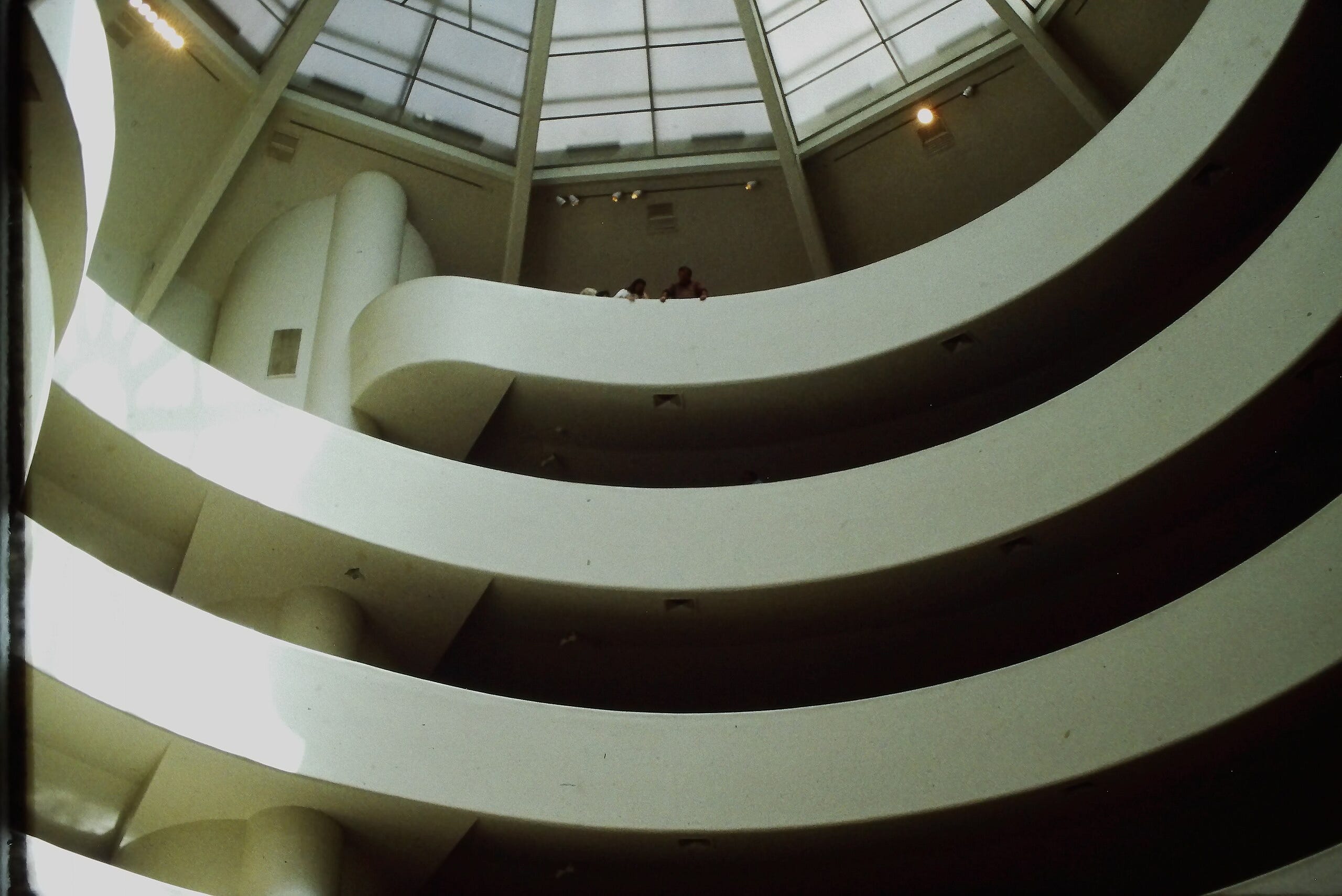
I can’t remember who suggested it, but we also went to the Guggenheim, where there was a major retrospective on Oskar Kokoschka, the Austrian Expressionist painter, marking the centenary of his birth. After marveling at the building itself, we took an elevator to the top and started down the long, winding balcony, walking forward in time past the fruits of Kokoschka’s early artistic development, and stealing quick, sidelong glances at each other between longer glances at sketches and paintings.
The images were a little dour, on the dark side, with mostly muted colors, a bit unsettling to tell the truth. Some felt as if they might be unfinished, and like the subjects’ inner feelings and anxieties were being exposed, rather than hidden beneath stylized exteriors. Their eyes seemed over-large and their hands captured in mid-movement, sometimes appearing a bit grotesque. The uneasiness grew as we walked on, and then, suddenly, around a bend, something partially hidden by a wall, and then: a splash of vivid color—a stained glass vision of brilliant light—stopped us in our tracks.
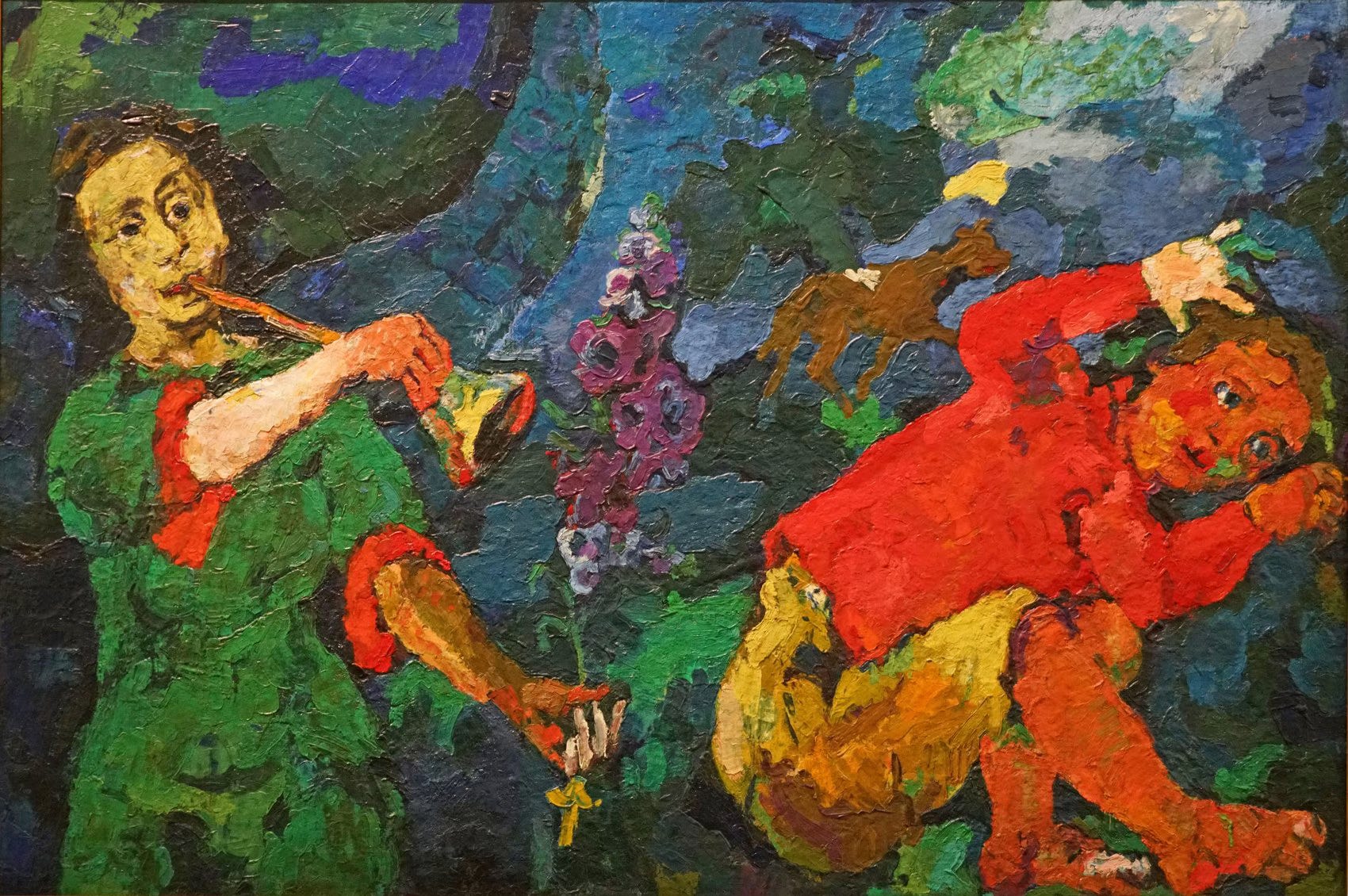
Great blotches of red, orange, yellow, deep blue, violet, that seemed to run into each other. A figure blowing a horn and holding a flower, and a boy leaning, surprised, reacting to something very powerful, irresistible, in fact. I just stood there, catching my breath. I came closer, to read the title. It was “The Power of Music.” And it was a moment. But I didn’t know quite how to react to it.
As fate would have it, that was the very painting the exhibition had chosen to grace the exhibition poster, and we each bought one. I framed mine, hung it in my studio and it’s been there ever since.
Now that it’s in its fourth home and fourth studio, it’s become somewhat faded with time and exposure to the light. I was remarking on it while I was practicing for the Messiah solo, and David encouraged me to replace it. As I started looking for a way to have it reprinted in its original vibrancy, it brought the whole New York experience back to mind, and I became more keenly interested in the story behind the painting, as well as Kokoschka’s own story.
One description I read compared his earlier works to listening spaces that create a sense of something about to happen. When music finally appears as the subject of this painting, about 1918, it feels less like a new theme than a release of the pressure that has been building all along.
Another said, “Kokoschka didn’t turn to music because it was fashionable. He turned to it because it was the only force large enough to carry what his early figures had been silently bearing.” Reading of his deep involvement with music and musicians throughout his life reinforces this interpretation.
The catalog for the Guggenheim exhibition says, “The painting should not be read as an illustration of music, but as an image of its effect—a force that enters, transforms, and alters the psychic state of the figures.”
One thing I totally missed the first time around was the painting’s innate similarities to traditional depictions of the Annunciation, when the archangel Gabriel announced to Mary that she would conceive and bear a son, the embodiment of God in human flesh. Now that I’ve learned a lot more about iconography (David has become something of an expert), I can see that the elements are all there. But instead of an angel, there’s a person playing music, and instead of Mary, we have a boy who is being transformed by the music. The flower (which is usually a white lily) is not a symbol of purity here, but a sign of conception, reception, and transformation—the moment when music enters a human soul and becomes life-altering.
Even though Kokoschka was not evoking the traditional theological meaning of the symbols, they are nevertheless full of meaning. In fact, for me—someone who tends to see a spiritual message in practically everything—it couldn’t have been a more meaningful moment if Gabriel had actually come down and blown his trumpet in my ear. It was definitely an incarnation of a sort: God inhabiting and speaking through music (and painting), to change and enrich my life. It was a definite moment. A flow moment.
That moment was described as “a hinge point” in Kokoschka’s Expressionism, but I could clearly see now that it was a hinge point in my expressionism as well. The parallels are impossible to miss. I had been marking time, progressing through a life full of rather dour representations of love, full of flat, dark colors and symbolic lines, unfinished, frustrated inner feelings and anxieties barely contained and clamoring to get out. And then, this revelation! There really was a different way to live, a way to love God, and still let the love and creativity of God break through. A way to let the exposed, sore, empty listening spaces fill with music and light and color and meaning.
In fact, when I think about it now, I might have had my own beautiful, red-haired Gabriel standing right there next to me.
We parted after that moment-ous day, and I would only see him one other time, my Gabriel. But in my heart I knew things had changed, and would never be the same again. I knew now that I could live a different way.
I’ll leave you with a song that expresses some of the changes I was going through at that time. For more backstory, lyrics and links, see https://doughowellmusic.com/songs/changes-in-the-air/
Oh, yes. And here’s wishing you a truly Happy New Year! (Or as we say in Hawaiʻi, Hauʻoli Makahiki Hou!) Will your new year be happy? Looks like a big part of that is up to you. Maybe more than you realized.
** Blue Guggenheim, Bryan Ledgard, CC BY 2.0 – Interior looking up, Emilio Luque, CC BY-SA 4.0 – In the museum, H.R. Tsua, CC BY-SA 4.0 – Guggenheim Soliloquoy, Dako Huang from Los Angeles, USA, CC BY 2.0, all via Wikimedia Commons
.jpg)
.jpg)

